Service, Setbacks, And A Second Act

You might have seen my “So, Let’s Catch Up” post, which offers a glimpse into the latter part of this story. But let’s rewind and start at the beginning. This is the complete account of my journey

Where do I begin?

The above picture shows me in 2002, during my first deployment to Saudi Arabia. It was my first time out of the country and my first time truly on my own. Since then, I’ve had several deployments, assignments, and temporary duty assignments (TDYs). However, in 2002, I was at the beginning of my career. Specifically, I was one year into my first assignment as an active-duty airman. Although I’d already had three years of military service, this was considered the start of my active-duty career—my first time answering my nation’s call. I was ready to take on the world and demonstrate my capabilities.

It was almost 22 years since that day, standing on the makeshift balcony outside the trailer that served as my office at Prince Sultan Air Base. Today, I am retired, but the journey to get here was quite an experience, and it began with the person in this picture. It all started because, three years into being a traditional reservist, I decided I needed to go on active duty.

Let me provide some context.

I initially joined the military in mid-1997, enlisting in the Air Force Reserve. My grandmother had convinced me that this was the best option. I had been struggling to find a job, and we believed that military service would provide the opportunities I needed. This belief kept me motivated to proceed with enlisting, even after my grandmother’s death later that year.

I spent three years as a traditional reservist. This meant that one weekend per month and two weeks per year, I served as an airman. The rest of the time, I was a civilian with a part-time job that I was trying to turn into a full-time position. While working part-time, I sought opportunities to work additional time with my reserve unit, but as a new member, those opportunities were not yet available.

As I gained more experience, the chance to work more duty time became available. Simultaneously, my civilian career progressed, and I transitioned to a full-time position. Furthermore, my girlfriend and I had married and were starting to discuss having children. However, as a junior member of the reserves, I was still required to complete my annual tour (my two weeks of duty) on base. Balancing my civilian job with my time on base, I still could not afford housing beyond my mother’s home.

By the end of my second year in the military and my first year in my full-time job, my wife and I began discussing the possibility and logistics of transitioning to active duty. The first recruiter I spoke with over the phone indicated that it was not a common occurrence. He stated that I would have to leave the reserves and rejoin, which was not possible with time remaining on my contract; for me, that was five more years.

A few months later, the military reduced the number of days I was required to serve, and several factors aligned. First, my wife informed me she was pregnant with our first child. Then, when we consulted a recruiter, we learned that the military was allowing reservists to transfer to active duty. This was in May 2001. After completing the necessary paperwork, we packed our limited belongings, and on August 20th, we found ourselves on a bus headed to my first active-duty base at Dover Air Force Base.

The First Problem

reenlistment

Upon checking in to my unit, I was informed that I should expect to serve three additional years because my reserve time would not count toward retirement eligibility. Several years after my first deployment, in November 2007, I received my first permanent change of station orders. I arrived at the Air Force Reserve Officer Training Corps (AFROTC) at Virginia Tech in January 2008. While there, shortly before my next deployment, I was told that I needed to be promoted or face separation from the military due to reaching my High Year Tenure. At the time, I was a staff sergeant, and the High Year Tenure was 15 years.

Calculating from 2001 to 2011, this is only ten years, not fifteen, indicating a discrepancy. It turned out that the three years I had spent in the Reserves were being counted as active-duty time. Fortunately, I was promoted.

Problem Number Two: My Unexpected First Retirement

Did you know that I effectively retired twice? After returning home from a deployment in 2017, I had to make several rapid decisions and arrangements to prevent my family from becoming homeless. During this period, I experienced significant physical exhaustion and mental strain.

Let me provide a brief recap. I joined the military in 1998 as a reservist. Three years later, I transferred to active duty. From that point, I understood that I would need to serve 20 years on active duty to be eligible for retirement, totaling 23 years of military service.

Now, returning to 2017, I had been in the military for 20 years, with 17 of those years on active duty. I received notification that I was scheduled to deploy. Almost simultaneously, I received an email informing me that I would be retiring upon my return from deployment. This was clearly incorrect, as I would only have served 17 years on active duty.

I made numerous phone calls, contacting everyone I could think of, to resolve the issue. I continued to argue my case even while overseas, but my efforts were unsuccessful. The decision appeared to be final: I was to retire upon my return.

Once back in the United States, I began preparing my family for post-military life. I started searching for a job, looking for a place to live, determining how to keep our children in their current school, and completing the necessary retirement paperwork. I returned to my office with 90 days remaining before my expected departure from the military.

My initial focus was on securing housing, as I had to vacate military housing before the 90-day deadline. Despite the challenges, we were successful. Within that short timeframe, we found a rental home near the base and moved out of military housing by my last day of work. The school district also granted an exception, allowing our children to remain in their school despite our relocation outside of the district. Things were improving!

I began terminal leave with a clear mind, knowing my family was taken care of, and I was eager to start my job search. As any veteran can attest, this is one of the most daunting and stressful aspects of leaving military service. Since 2005, I had been told that I was well-positioned to find employment after leaving the military, given my master’s degree and extensive experience. However, the prospect of searching for a job after so many years of consistent employment was still a significant source of anxiety.

My fears soon subsided. I not only found numerous job postings to apply for but also began receiving interview requests. While there were rejections, I also received several callbacks, recommendations, and job offers within a short period. In the month before my scheduled departure from the military, I applied for over 100 jobs and interviewed for 30.

On the day I received a call about the most promising job opportunity, the military once again upended my plans. To be clear, I had no intention of returning to the military. I had grown my hair out, and my uniforms were in storage. I was simply awaiting my official retirement paperwork (DD214), which was scheduled to arrive in just five days. Then, I received a phone call requesting my presence to sign my final performance report and finalize the reservations for my retirement ceremony. Upon arriving, I was informed that my retirement was halted.

It turned out that someone had reviewed my record and determined that my initial assessment was correct; I was not yet eligible for retirement. Within 20 minutes, I went from planning my retirement to planning my reenlistment. The military rescinded my retirement orders and reinstated me to active-duty status that same day. Consequently, instead of a retirement ceremony, I had a reenlistment ceremony. Fortunately, my family, who had come to town to attend my retirement, was present for my reenlistment. I quickly completed the necessary paperwork and prepared to reenlist for the three years I still owed.

Ultimately, it all worked out. I ended up serving one extra day on active duty because the paperwork processing was delayed. However, that single day was preferable to the alternative of being forced to separate from the military.

After thoughts

In 2021, I finally retired from active military duty; I originally wrote this in May of 2018. Now, you have the entire story. The last few years of my military career were over before I knew it. But things did not go as smoothly as I thought they would have liked. In the last year, my retirement application was denied multiple times, sparking significant concern and stress. It seemed that almost the same day I submitted my retirement paperwork, I was also tasked to deploy. But I was never officially notified. The powers that be said that the denial of my retirement was the official notification. But I was done. It took an additional 4 months beyond the time I wanted to retire to get everything squared away and finally get an approval. In May of 2021, I walked out of the door of my office as Technical Sergeant Corey L. Stokes, United States Air Force, Retired!

It took me a while to actually post this; I wasn’t sure exactly how much I wanted to share and if I wanted to share it at all. I needed space from it all before deciding to move forward with it. While the last three years of my career and this entire experience were less than ideal, I wouldn’t trade my time in service for anything. I still say my years of service in the United States Air Force were some of the best experiences of my life. 

When I decided that I was finally ready to retire, people told me that I should take a break before going back out to work. To tell you the truth, I gave it a lot of thought. By the time I went on terminal leave, which is unused vacation time, in May 2021, I was committed to staying home for a time before starting my job search. But after thirty days of being at home, my anxiety about being able to find a job got the better of me. Here is what happened.

My last day in the office before I started terminal leave was May 7, 2021.

Before you leave the military, you have to go through the Transition Assistance Program (TAP). This is a course designed to help prepare you for reentry into the civilian world. My wife and other family members told me that I had nothing to worry about. They said I was in a great position to enter the civilian job market. However, TAP and other sources advised taking a break to “demilitarize” and cautioned against expecting my first post-military job to be my forever job. After taking the transition assistance course, I felt strongly that finding a job would take me a year or more. I believed that taking a break would be the better option.

I started my terminal leave on May 7, 2021. I’d applied for a few jobs to alleviate some of my nervous energy. To my surprise, I received callbacks and interview requests for each of those jobs (I could almost hear my wife saying, “I told you so.”). By mid-May, I had several second interviews scheduled. But I’m getting ahead of myself.

I was not disillusioned about my prospects for finding a job, though I was anxious about supporting my family after the military. Even though we had 4 months of continued pay during my terminal leave, we prepared our budget so that my wife’s income would cover our bills, ensuring that she had us covered if my job search took longer. This alleviated some of the stress. But, the idea that it’s my job to be the primary provider, an idea instilled in me, remained.

If you take away one thing from this post, please understand this: If you are going through a transition period, and your significant other can support you and give you the space to transition, be thankful! Accept their support! Knowing that my wife could take care of us until I found a job released a great deal of the pressure I felt to quickly find employment.

In the short few weeks that I was home, I relaxed! I started making and drinking honey wine and beer. I planned a trip to see my family, and I applied for jobs that interested me—and I did so without stress. I fully expected a lengthy job search. However, by mid-May, I’d received several second interview requests from promising employers. Towards the end of May, I even added yard sale shopping to my list of activities. That’s when I knew I needed to return to work. I am not a yard sale person. Three weeks into my terminal leave, I officially began my job search.

I made finding a job my full-time job. I searched during the day, took notes, and marked jobs that interested me. I took a lunch break and worked out. Then, in the afternoon, I reviewed my list and applied for the jobs I chose and those my wife sent me. At the end of each day (5:00 PM for me), I updated my spreadsheet with all the jobs I had applied for and interviews completed. Yes, I had a spreadsheet!

By the time June arrived, I had applied for 50 positions. I had completed twenty-five interviews and was considering two offers. I was a man on a mission. I had not been on terminal leave for a full 30 days and had already received 2 job offers—completely contrary to what I expected after TAP.

I started working on June 21, 2021, three months before my official retirement date.

I could say that my preparation, skills, and experience from the last twenty-three years secured me an excellent job right out of the military, and that might be true. However, I also believe that I had impeccable timing. The perfect job, requiring my specific skills and experience, became available precisely when I became available. Perhaps the saying “luck is where skill meets preparation” is accurate; I feel I was lucky.

With a one-year probation period, I was cautious and questioned everything. I soon realized that I defaulted to military-based responses. On more than one occasion, someone told me, “This isn’t the military.” In one email to my supervisor, who was providing information about an upcoming meeting, I replied, “Roger. v/r Corey.” A response I’d sent countless times over the past twenty-three and a half years. I thought nothing of it until she called and asked what it meant. “Try not to use military language here,” she said. “Not everyone will know what you are talking about.” Consequently, at my next staff meeting, I asked my team to point out any instances of military jargon, as I often didn’t realize I was using it.

And point them out, they did. A few months in, I asked my team for feedback on my performance. For the most part, they said I was doing well. One person, however, said he thought I was “a bit draconian.” What the hell does that mean?

Definition of draconian

What I initially thought he meant was that my standards were high and difficult to meet. However, “draconian” actually means unusually severe or cruel—especially regarding punishments. I hadn’t punished anyone. He later clarified that he probably used the wrong word, but it still made me reflect. What was I doing that gave him that impression?

There were a couple of instances where I corrected some of his mistakes, but that was part of my job. And he received the least amount of correction. If anyone on my team makes a mistake, my supervisor is notified, and she, in turn, asks me for an explanation. This prompted me to establish clear standards. This way, when I receive a call from my supervisor, I can readily respond, or even better, I can proactively inform her of any issues. There’s nothing worse than being caught off guard by a problem. So, I wanted to stay informed about potential issues. I also wanted quality checks before deliverables. If a mistake was found, it should be fixed, and the customer notified. If a delay was expected, the customer should be called, not just emailed. And if something wasn’t understood, questions should be asked immediately, rather than waiting for clarification. To me, that approach simply makes sense. Although it became a running joke in the office, I consciously tried to be less “draconian” for the remainder of that first year.

Two years in, I noticed that my team had started to pick up on some of my lingo. This suggested to me that I was adapting well, even with my military influences. I was enjoying my role. Had I stayed in the military and accepted another assignment, any of the offices I was now managing would have fallen under my area of responsibility. I loved it. Still, I was concerned because I remembered the TAP instructor’s warning: “Don’t expect your first job to be your forever job.” 

Now, with this post, almost 4 years later, I can officially close that chapter of my life and move forward. I believe I have found a place that will help me to grow into the next version of myself.  But stay tuned; I’m not done yet! I’ll be sharing more of my journey in the future.

Don’t say I can’t do it, Ask, How can I do it?

I’ve learned a valuable lesson over the years: when you say you can’t do something, it’s like a red flag that signals the end of the conversation. You’ll never be able to pursue your dreams or goals if you keep saying that. Your brain treats it as a final decision, so there’s no room for further exploration or growth.

We often fall into this trap with money. When we see something we want, we might say, “Oh, I can’t afford that,” and our brains just move on to the next thing on our list. But instead of giving up, let’s try a different approach.

When you face a challenge, your brain goes into overdrive, trying to find a solution. I recently experienced this firsthand. After an injury, I couldn’t run the way I wanted to, and I was afraid I’d never be able to run again—a hobby I loved. But instead of telling myself I’d never run again, I asked myself, “How can I do this again? How can I run races again?”

My mind, along with the support of my family, worked hard to find a solution. And guess what? We found a way to get me back on the track! I even managed to complete two races!

So, here’s my advice: stop saying what you can’t do. It’s a limiting belief that holds you back from achieving your goals. Instead, ask yourself, “How can I do this instead?” This opens your mind up to a world of possibilities and solutions.

Have a fantastic financial fitness Friday!

On 4/6/2025 I ran 6 miles in just under 1:40:00. I didn’t say I couldn’t do. I asked how can I make this happen.

Stepping Out: A Race, Community, and Connections

written by Corey Stokes

One act, a simple raffle entry, transformed a race weekend into a series of remarkable connections. If you know anything about me, you know that quiet is my default setting, a bit introverted, much to my dismay. But I’ve worked hard to push beyond those boundaries. Over the years, I’ve deliberately placed myself in situations that demand stepping outside my comfort zone, a process that has yielded unexpected rewards. Last year, while running my first race post-injury, I made a point to engage with people at the staging area. I spoke to fellow runners, a familiar face from a volunteer event, and a vendor promoting a race in Liberty, Missouri. That vendor’s encouragement to enter a raffle, which I won, set the stage for a weekend I won’t soon forget.

My wife and I decided to make the Liberty Jewel 5K and Half Marathon a weekend event. The decision was finalized on the way to Liberty, Missouri, during the three-hour drive from Wichita. And man, was I glad we did. But let me not get ahead of myself.

The Race:

We arrived the night before so we could get a good night’s sleep and be well-rested for the race the next day. We had no idea what we were in for.

We didn’t do anything special other than the normal training for the race, and the day we got into town, we ate at a local restaurant. The food was amazing, by the way. We could smell the grill as soon as we stepped out the car. We woke, dressed, and made our way to William Jewell College to pick up our race packages. While I parked the car, Michelline got us checked in and started to prepare for her race, the half marathon. With the car parked, I set out to join her so I could ensure I got some pictures commemorating her ninth half marathon. Although, I’ll admit I didn’t discover that number until later.

Then local photographers took pictures as the racers lined up, the national anthem was sung, and she was off at 8:00 on the dot. Her goal run time, as we discussed before she started, was to finish with the three-hour group.

Now that she was off and running, it was time for me to mentally prepare for my run. I stretched and did a few warm-up drills…

The bell sounded, and we were off! First, somehow, my run timer was all messed up when I pressed start on my phone. I thought about leaving it and just running with the incorrect settings… but that was not how I trained. While I wasn’t expecting this to be my best 5K ever, I did want it to be better than the race I’d done five months previously. So while we inched closer to the starting line, I hurriedly fixed my timer, then pocketed my phone. I was off. No race starts without some type of malfunction—especially with technology involved.

Second, oh my God! Who puts a hill at the start of the race? I went back and forth during my training on whether or not I’d run my starting five minutes to warm up or walk it. Running it won the debate. So as I turned the first corner and was confronted with the first of many hills of the race, I swore a bit under my breath and said, “What the hell am I doing?”

I finished the race, officially 14 minutes faster than my time in the Salina race. Despite the devastation of all the hills, I’d managed to stick to my race plan, except on one hill. The cheerleaders on the side of the road cheering the runners on helped to motivate me to keep moving. I high-fived each of them as I ran past. 44:46 was my official time crossing the finish line. Not bad for being eight months post-injury. I was happy with my time.

She too had the same experience with the hill; she was definitely not happy. She finished the race 15 minutes slower than she had wanted to. Her official time was 3:15:00! Although she was a bit upset at her finish time, she killed it, and her ninth half marathon was in the books.

Meeting People:

Initial Interactions and Black Men Run:

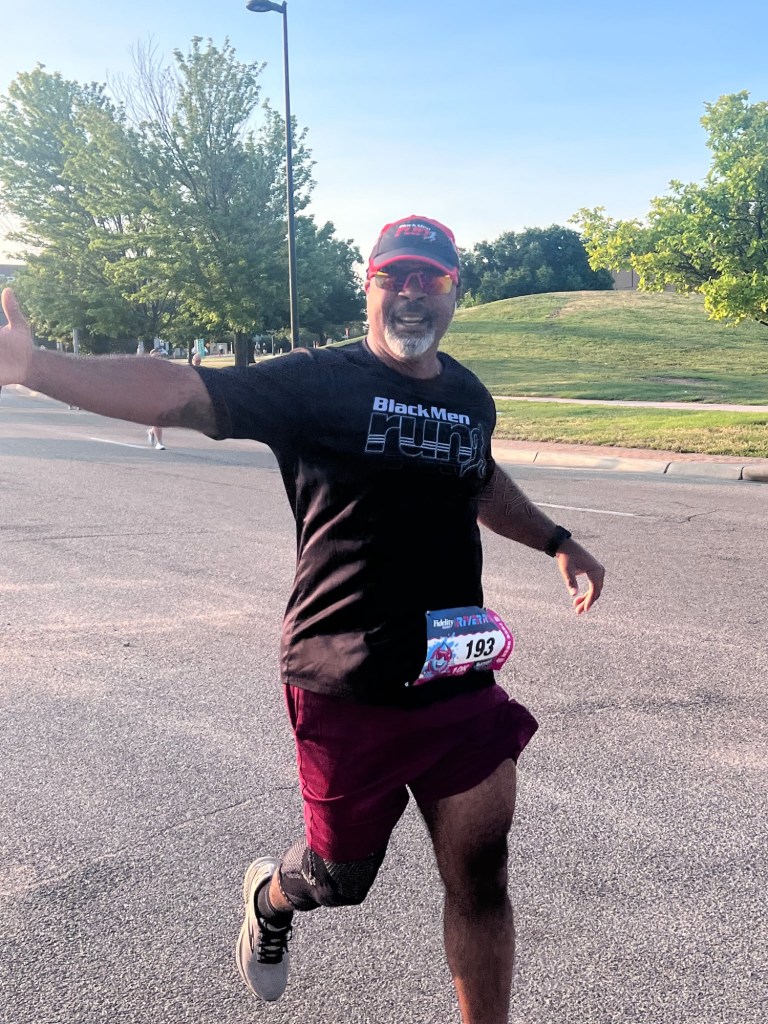
“I attended the race representing my run group, Black Men Run. Although I am the only member from the Wichita area (that I’ve been able to determine), I promote the organization’s goals everywhere I go. This race was no different.

I looked around and noticed that there were not a lot of black men at the race; in fact, I appeared to be the only one. But then I spotted one other, and my wife encouraged me to go speak—or at minimum, offer a word of luck on his 13-mile run. After a moment’s hesitation, I did just that.

…I noticed a man inching his way towards me. He stood beside me and began to speak… “You know, black people also play basketball… and tennis… hell, they can play anything they want,” he said. I smiled and said, “True,” as he expressed his admiration for my Black Men Run shirt and walked away.

I paced around for a bit, trying to get some of the nervous energy out. I don’t know why, I get nervous before a race, never during a practice run, but only on race day. (I blame Air Force PT test day for the jitters.) But, I noticed a lady looking at me. “I like your shirt,” she said. I explained to her that it was a shirt from my running group and began to tell her about the group. I wasn’t surprised she’d not heard of the group, but she appreciated my explanation of the run group, and we began to speak about our race day goals. Before we parted, we followed each other on Strava.

Not long after, a guy chuckled at me, asking, “Do they now?” I explained the run group and its goals. He asked if anyone else was there. We scanned the crowd, and it was obvious I was the only black face there. “I guess not,” he said.”

Meeting the Mayor:

“A few moments later, this same gentleman brought another runner over to me, “You have to meet this guy, he came in from Wichita, he’s the only black man here,” he said as he introduced me to the Mayor of Liberty. We shook hands and wished each other luck on our upcoming runs. Pretty cool, I thought to myself.”

Connecting with Fellow Runners:

“During the run, I’d passed and been passed by several black runners that I just did not see at the starting line. So, when I was done, I found as many of them as possible and congratulated them on their runs. I also took the opportunity to let them know about the run group. One guy noticed me on the path and asked me about my shirt when I approached him after the run. “#runwithCorey… Who’s Corey?” he asked. I introduced myself and sparked up a conversation.

There was no malice or ill intent in the words of any of these interactions; I welcomed each of them. Everyone was genuinely curious about what I was wearing and surprised they hadn’t noticed the lack of black faces at many races they’ve attended. After the race, one person even commented that many of the races she’d been to were “pretty pale.”

The Til Valhalla Project Connection:

“When I’m not supporting Black Men Run at races, I’m supporting the military community, including some of the organizations that bring awareness to the issues that our veterans face. One such organization is the Til Valhalla Project. They bring awareness to veteran suicide. While none of the veterans I know have died by suicide, I do know family members and friends of those who have. So when I spotted the Til Valhalla T-shirt at the finish line, I walked over to the young lady wearing it and asked if she served in the military. She said she didn’t, but her husband, who died by suicide, served in the Navy. I expressed my condolences, briefly said hi to the friends she was with, and waited for my wife to finish her race.

We walked around for a bit, and I spotted the Til Valhalla T-shirt group, so we headed towards them. This time, we exchanged introductions and talked for the rest of the morning. By the time any of us realized the race was over and cleared away, and the coordinators and volunteers were starting to leave, our two cars were the only ones left on the grass.

From that brief conversation about the TVP shirt, we’d hit it off and made some new friends. It turns out that the group was not a military crew like I’d originally thought but a group of local police detectives. We all went out for lunch and a drink after the race with promises to keep in touch and look to see each other at future races.

Like I said, I was glad to be able to stay an additional night at the hotel that we booked to make our runcation a weekend getaway. By the time we got back to the hotel, we were both exhausted. We laid down and were knocked out for three hours. For me, the weekend was a reminder that stepping outside of my comfort zone could lead to unexpected connections. This race was definitely an event to remember. It was a weekend that proved that sometimes, the most significant victories aren’t measured in miles or minutes, but in the unexpected friendships and experiences forged along the way.”