Author Dan Miller issued a suggestion to his podcast listener. The suggestion was, take a millionaire to lunch and to pick his brain. Unfortunately for me, In my world. Millionaires are not really a dime a dozen. And If they are, the are not really broadcasting their location. Lucky for me, however, that Richard Paul Evans shared lessons that he learned from a Millionaire.
It is definitely a book to have in your library. If only to refer back to the 5 lessons or the 4 Millionaire Mindsets. I started reading the book on a Sunday night and finished it Monday morning. Out of the 133 pages in the book 20 or so pages are devoted to forms and resources that you can utilize to practice living the 5 lessons, leaving 106 of lessons and tips for the road to wealth.
The lessons are not new lessons, In fact, each lesson looks similar to the works of other’s studying the rich or how money works. “You are what you think you are”, “Control thy expenditures”, “Pay yourself first”, “Win in the margins”… okay, I really couldn’t think of an analogy for this one, but If you study the life of Warren Buffett, I’m pretty sure you’ll see a correlation. To Mr. Evans’ credit, in reading this book I did not feel like I was reading a recapture of the works of other authors.
It is said when interests meet passion, you will find your happiness. And if someone is willing to pay your for it, you may just have the starts of a really unique and profitable business. Or you may just have a a great tool to share with the world. My interest in success and money, lead me to George S. Clason. My passion for technology, lead me to create a tool to answer the questions “how much life can I afford”?
Prior to me seriously becoming a student of how money works, I would hear people say, “you have to live below your means” so you can begin to build wealth. According to Dr. Thomas Stanley, the majority millionaires are frugal individuals who do not spend lavishly. They work hard, and where there is a deal to be found or a discount to obtain, they will find it. They do not, spend money on flashy car’s or things that go down in value. No, the majority of people with money got it, and keep it because they are smart with it, they live below their means. Luckily for the non-millionaires reading this, George S. Clason (1874- 1954) left a road map to a “fattened purse” in his book The Richest Man in Babylon so that we may catch up pretty quickly.
If you haven’t read the book yet, I encourage you to take a look at it. It will change the way you look at your budgeting! If you have read it, here is a recap of the 7 Cures for a lean purse!
Based on these 7 Cures, what does living within your means look like for you?
The Seven Cures for a lean purse are as follows:
Fatten thy purse (Save) – “If thou select one of thy basket and put it into each morning ten eggs and take out from it each evening nine eggs what will eventually happen? It will become in time overflowing”
Control Thy Expenditures (Live within your Mean) – “All men are burdened with more desires than they can gratify”
Make thy gold multiply (Investing) – “The gold we may retain from our earnings is but the start. The earnings it will make shall build our fortunes.”
Guard thy treasures from loss (Having an Emergency fund)- “Prevent thy purse from being emptied once it is filled”
Make thy dwelling a profitable investment (Home Ownership)“Thus come many blessing to the man who owneth is own house.“
Insure a future income (Build wealth) – “The life of every man proceedeth from his childhood to his old age. This is the path of life and no man may deviate from it unless the Gods call him prematurely to the world beyond. Therefore do I say that it behooves a man to make preparation for a suitable income in the days to come, when he is no longer young, and to make preparations for his family should he be no longer with them to comfort and support them. This lesson shall instruct thee in providing a full purse when time has made thee less able to learn.”
Increase thy ability to earn (invest in your own education) – “Always do the affairs of man change and improve because keen-minded men seek greater skill that they may better serve those upon whose patronage they depend.
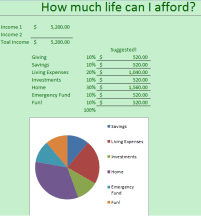
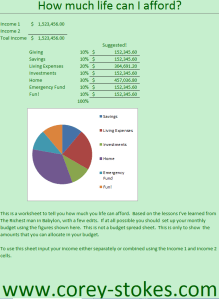
Many of the links on this page will talk you to the tool to help you answer the question How much life Can I afford, if you are saving 1 tenth of your income, putting money aside for investing, building an emergency fund, and how much a house payment should be based on your income (you decide the figure that is used for the calculation).
For the past ten years, since my study of how money works began, I have used similar spreadsheets in order to help build a working budget to ensure I am living within my means.
Enter your income into the fields provided for Income. The suggested figures will automatically populate with how much of a life you can afford. The goal of living within your means is to have a budget based on the area Marked Living expenses. This is everything with the exception of rent/mortgage and utilities (These items are addressed with your Home section).
If you have debt, then this comes out of your living expenses. only after you have paid for your necessities. As Dave Ramsey has said, once the balance is zero, your are done! If you still have “month left at the end of the money” you’ll have to take those funds from somewhere else, within your budget, in order to meet your obligations.
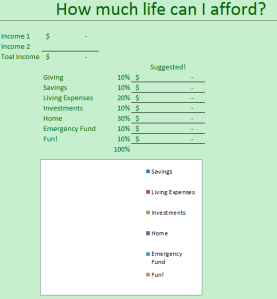
I’ve included on the tools page 2 versions. First, you can input your income, and use the generally used percentatges, similar to those found in The Richest Man in Babylon. The second is a full editable version so you can play with the percentages to fit your needs.
People that I have showed this toold to, either love it or feel they cannot not do it. After living with this and similar tools for the past ten years I’ve gotten it to where it works for me.I encourage you to do the same. See what living within your means should look like based on your income.



 Corey Stokes
You must be logged in to post a comment.