Sexy-time Workout

I wholeheartedly believe that there are gems hidden in books. If you haven’t realized this about me, well, now you know. This is why I don’t limit the type of material that I read. I could be reading a research paper one moment, and a thrilling drama the next. Regardless of what I’m reading though, I try to find something useful to take away from the material. This time, I was reading a book on exercises.

I found a gem of a workout routine, and have dubbed it the “Sexy-time” workout. A few months ago, my wife presented me with an exercise book. If you follow any of my social medias you know that I’m all about my exercising. But, I don’t alway enjoy coming up with exercises. I like to push myself with new routines, and focus on technique and form rather than speed and heavy lifting. So, when my wife gave me this Men’s Health exercise book, I was ecstatic.

I am making my way through the workouts in the book, modifying or changing out what I physically cannot do, and challenging myself every step of the way. What really peaked my interest though when I read the table of content was the workouts for better sex section (whoa, big surprise I’m a guy with sex on the brain)!

At first, I didn’t want to read this section, thinking “my wife isn’t complaining, I don’t need this.” And I skipped around it for a few months. Until one Saturday, I was flipping though the pages and not paying attention to the headings. I saw a workout with squat punches, push-up rows, and thrusters; and I was intrigued. I was doing push-up rows occasionally, but I’d never thought to add weighted punches while doing squats my squats. I wanted to know more so I flipped to the beginning of the section. It was the workouts for better sex section of the book.

The first time I did the routine, I did it as prescribed. I feel in love after the first set. I now incorporate many of the moves into every workout that I do. But the routine itself was not what sold me on the workout, although it was a great workout. What sold me was the explanations for the specific move.

The workouts focus on flexibility, stamina, stability, fat loss, as well as visual appeal— building muscles definition for maximum performance and appeal. The book provide 5 different routines that you can do with or without weights in 15 minutes. If you are feeling a bit “extra” you can even combine them and make a workout to suit you desired outcome.

Here is my favorite routine.

This can be done as basic sets, an AMRAP, Waterfall (start with reps of 10 for example, and work your way down to 1)… the combinations are endless. This can also be combined with a run for extra cardio.

Start with a Warm up – 5 minutes

The moves

Squat Punch (Alternating)

Row push-ups

Jump squat curls

Single arm KB Swing (L/R)

Squat thrust

Explosive push-ups

Roll-out

Cool down – 10 minutes

Try this: Waterfall from 10 – Perform each exercise for 10 reps. When you are done, repeat for 9 reps, and again for 8….until you get to 1. For a challenge, when you get to 1, reverse course and go back up to 10.

Will running everyday hurt me?

Chances are, you know someone or, you are someone who runs on a daily basis. I used to be one of those people. In fact, when I was running daily, is when I saw most of my fitness improvements. But, I also saw a lot of injuries. When I started to feel pain, that’s when people started to tell me, you’ll get hurt if you run everyday.

According to a website that I found, daily running (15-30 minutes a day) could have great health benefits. But it also increases the likelihood of injury, such as damage to the knees and a variety of strains. That is why some experts say that beginners should limit their runs to 2 to 3 times per week. More advanced runners can run more, but know that for the average person, according to Healthline.com, running loses its benefits after 4.5 hours per week.

Personally, I like to add weight training days in between my run days. I am a self proclaimed runaholic, as my wife has termed it. Which simply means that If i was given a choice, running would be my go to exercise. I didn’t always like to run, though. In fact, I hated it. But that was because when I ran I tried to measure up to the expectations of others. Once I figured how to run for my own benefit, I learned to enjoy it, and didn’t want to stop.

It wasn’t until I got hurt that I started slowing down. It happened while I was training for my first half marathon. I’d reached a new milestone, 9 miles, and was working towards the next milestone, 10 miles. That is when I started feeling pains in my legs. I would start to walk and stretch it out as I felt the pain. But, as time went on, the pain began to get stronger and more frequent. Eventually, I could not run a mile without feeling pain in my legs. Doctors could not tell me what was wrong. Physical therapist could not fix it. The only advice that I received from either was don’t run so much (Incidentally, the same story is true for my shoulders, but we’ll hold that for another day). With the military as my full time career, not running was not an option.

Financial fitness is also fitness
Financial Coaching – Schedule your free appointment today

That was when I reached out to a running community. I connected with Black Men Run Kansas City and asked my questions to the guys in the group. Here is some of the advice that they gave me:

If you are running daily, change your shoes often. Chances are your shoes will give out before you do. So change them every 200-300 miles. Also, use your running shoes for running only. My running shoes were also the shoes I’d wear frequently. That added to the wear and tare, which means they broke down quicker. The group helped me to see that I needed to have a pair of sneakers that I used only for running.

Next and probably the most important advice they gave me, stretch often. Stretching is probably more important than the run. While I was running every day, I was not stretching at all. Not stretching basically will cause your muscles to tighten up, which will cause pain. Stretching allows your muscles to remain loose and limber, and keep you pain free.

Finally, warm up before every run. No, I don’t mean do a slower paced run before you open it up on the road. I mean do a 5 minute warm up to loosen up your muscles and get them ready to work. If you need a warmup, this one is my favorite.

FitnessBlender 5 minute warmup

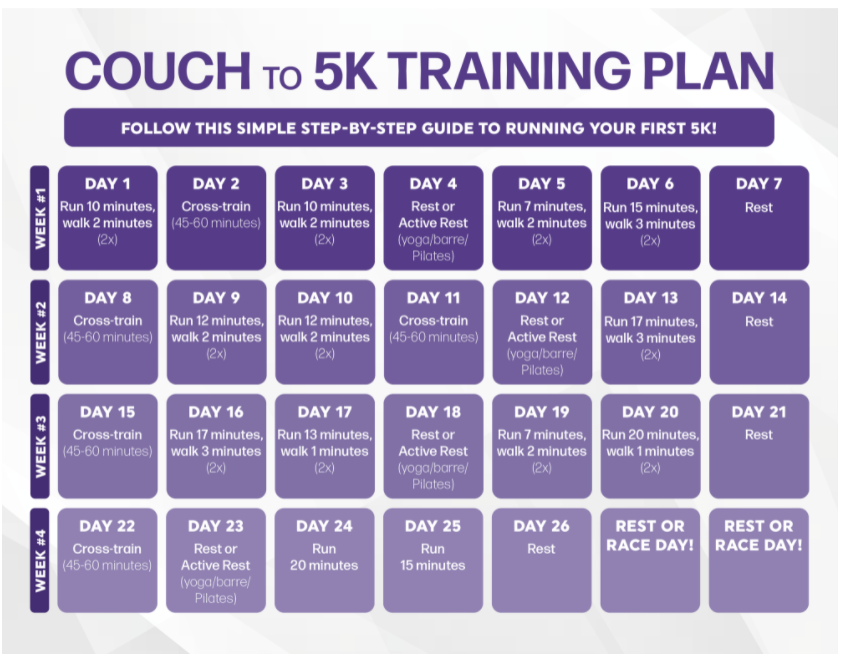
Will running every day lead to injury? The short answer is yes it could. Running every day does have the potential to cause serious injuries. If you must run every day , remember to warm up first, cool down, stretch after each run, and change your shoes often. If you don’t have to run daily try the run schedule below. Staying injury free, is the best way to stay motivated about running and fitness in general.

A basic running plan

Resources

Couch to 5K – https://nurecreation.com/sports/2020/7/8/randy-walker-memorial-5k-couch-to-5k.aspx

Running Everyday – https://www.healthline.com/health/fitness-exercise/running-everyday

The Importance of stretching – https://www.health.harvard.edu/staying-healthy/the-importance-of-stretching