
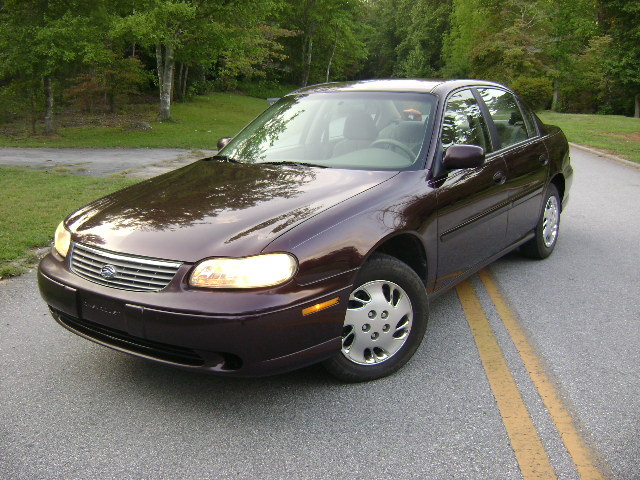
Do you remember the story of my Chevy Malibu? I think I mentioned it in my last post. Long story short, I got, got! This is what happened. First let me just say, I really loved that car. It was the first care that I bought for myself that actually work. If you asked me now, I don’t remember what was actually wrong with Mali, But I didn’t think it was going to be that big of a deal. In fact, When I bought it to the dealer based mechanic one morning before work, I was expecting to be in and out. But instead, thirty-five minutes later, the technician came out to talk to me and gave me the shock of my life.
“Mr. Stokes, So we located the problem. You have a blah, blah blah…. the part will cost about $1000, what would you like to do?” Truthfully, I really don’t remember, the part that needed replacing. I just remember the heartache I felt when he told me I wouldn’t be driving Mali home. While he was talking to me, all I remember hearing is that it would cost me $1000 to fix the problem.
Back then, I was not in a position to pay this price. I’d maxed out all of my credit cards didn’t have the cash in my bank accounts, and my credit was so poor, that I could not even get a loan to cover it. I was completely distraught. When I tried to tell him I would bring the car back when I had the money, the technician told me he, didn’t feel comfortable letting me drive the car in its current conditions. Eventually, he agreed to take my car as a down payment for a brand new 2005 Nissan Quest.
Maybe one day there will be a blog post about the Quest, but for this story. let’s focus on the fact that a $1000 problem landed me into the sensuous grasps of a $40 thousand dollar vehicle and loan. What’s more, to get my payment to stay in the same vicinity as I was making on Mali, the dealer happily extended the terms of my loan from the standard 36 months to 72 months.
Now, you probably reading this and thinking ‘this Corey guy is pretty smart’. Let’s think about it for a moment. Instead of spending $1000 to fix a problem, I ended up spending $40,000. The technician smiled that he was able to solve the problem with my Chevy Malibu… I no longer had that problem. Instead, I now had a new minivan to go with my $40,000 loan. Who was really the smart guy?
My wife and I say “we don’t long hard lessons we learn expensive ones”. I wish I could say this was the only expensive mistake that I had to learn, but it wasn’t. We, meaning I, made several more expensive mistakes before it finally sunk in. I needed to put some space between me and a hard time.
Putting space between you and a hard time gives you the mental bandwidth to think about your solution to a problem instead of taking the first option that is presented. That space gives you the freedom and the ability to respond to a problem instead of reacting to it. In short, this space gives you choices.
There are plenty of ideas about what that space should look like. But, in a nutshell, put some amount of money in an account, to handle anything that comes up. This is your baby emergency fund. I recommend $500 -$1500. Depending on where you are in your life will determine the amount of space you need.
No, I’m not saying that all you need is a $1000 emergency fund. A full emergency fund should be between three and six months of your income or your expenses. But until you get to that amount, and while you are still trying to live life, a $1000 buffer between you and a rough patch will go a long way.
If I would have had this buffer of $1000, fixing Mali would not have been a big issue. I could have simple paid for the repair. When I purchased my first home in 2006, learning from Mali was put to the test when the water heater went out. The $1000 buffer was more than enough to help me fix the problem without throwing my world through a loop.
Some would recommend having a credit card to handle these situations. personally I do not recommend this course of action. For one thing, I don’t think that debt should be used as a tool in your financial plan, therefore I do not recommend credit cards. Also, If you are trying to recession-proof your life, borrowing money is not the way to do it.
I once asked a question to my social media feed. “What would you do if you had an extra thousand dollars?” My answer is simple. I wouldn’t do anything with it. I leave it along and let it give me peace of mind. Knowing that I can handle life, as it comes up will allow me to focus on more important things; like building a full emergency fund to get more space between me and the inevitable and eventual hard time.
 Corey Stokes
You must be logged in to post a comment.